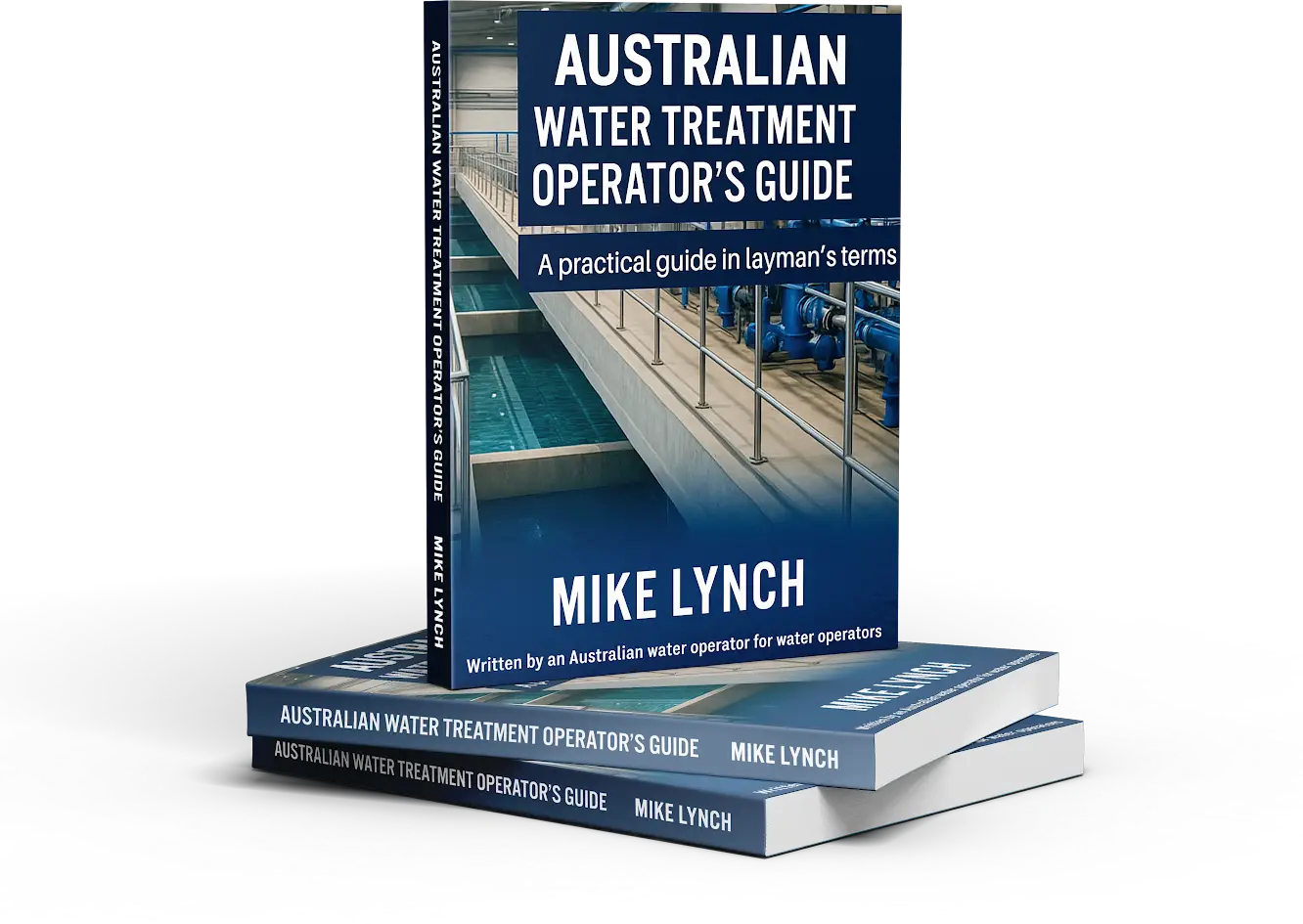
Australian Water Treatment (operator’s) Guide
Practical, field-based guidance for operating Australian water treatment systems
This guide is written for people responsible for producing safe drinking water under real operating conditions. It is intended for operators who manage treatment systems daily and who are expected to maintain compliance, reliability, and public health outcomes with limited margin for error.
This is not an academic text and not an overseas manual adapted for local use. It is a practical reference built around how Australian water treatment plants are actually operated in the field.
Why this book exists
Many water treatment operators rely on documentation that is either overly theoretical, written for ideal conditions, or disconnected from the realities of regional and small community operations.
This guide exists to provide practical, usable guidance that reflects Australian standards, operating environments, and regulatory expectations. It focuses on what operators need to understand to keep systems stable, compliant, and producing safe water day after day.
What this guide covers
The book provides clear operational guidance across a range of Australian water treatment systems and processes, including conventional and small scale treatment arrangements.
Strong emphasis is placed on routine operation, monitoring, and process control. The guide explains how treatment processes behave in practice, how issues typically develop, and how operators can respond methodically and safely when conditions change.
The focus throughout is on practical operation and decision making rather than theory alone.
Who this book is for
This guide is written for water treatment operators, water and wastewater supervisors, council operations staff, regional and remote system operators, and operators working toward or holding Cert III or Cert IV qualifications.
It is also suited to experienced operators who want a reliable reference they can use on site.
Who this book is not for
This book is not intended as an academic reference, an engineering design manual, or a substitute for regulated design documentation.
Its purpose is to support day to day operation, not detailed design certification or consultancy level modelling.
How this guide is different
This guide is written by a practitioner with long term experience operating, troubleshooting, and supporting real water treatment systems in Australia and internationally.
The content reflects the realities of operational environments, including ageing assets, variable raw water quality, staffing constraints, and compliance pressures. It is structured so operators can apply the guidance directly to their own systems.
How operators use this book
Most readers use this guide as a practical reference during routine operation, a support tool when systems are not behaving as expected, and a confidence check when making operational decisions.
It is also used as a training support resource for new or transitioning operators.
Format and availability
This is a printed reference manual designed for use in operational environments. The content is structured for clarity and ease of use, allowing operators to quickly find relevant information when needed.
The guide is written entirely within an Australian context.
Final note
Water treatment is a public health responsibility that depends on consistent, informed operation rather than ideal conditions.
This guide is written for those realities and for the operators who manage them every day.
If you are responsible for producing safe drinking water and maintaining compliance under real world conditions, this book is designed to support that responsibility.
Pricing and value
This guide is priced as a professional reference, not a general interest book.
It is written for people who are responsible for operating regulated infrastructure, where mistakes carry real consequences. The value of this guide lies in its practical focus, Australian context, and the depth of field experience behind the content.
Unlike low-cost manuals or generic overseas references, this book is designed to be used repeatedly over time. Many readers use it as a working reference during routine operation, troubleshooting, and training rather than reading it once and setting it aside.
For councils, contractors, and operators, the cost of this guide is minor compared to the cost of operational errors, compliance issues, rework, or avoidable downtime.
This publication is priced to reflect the level of practical expertise, responsibility, and real-world application it is intended to support.